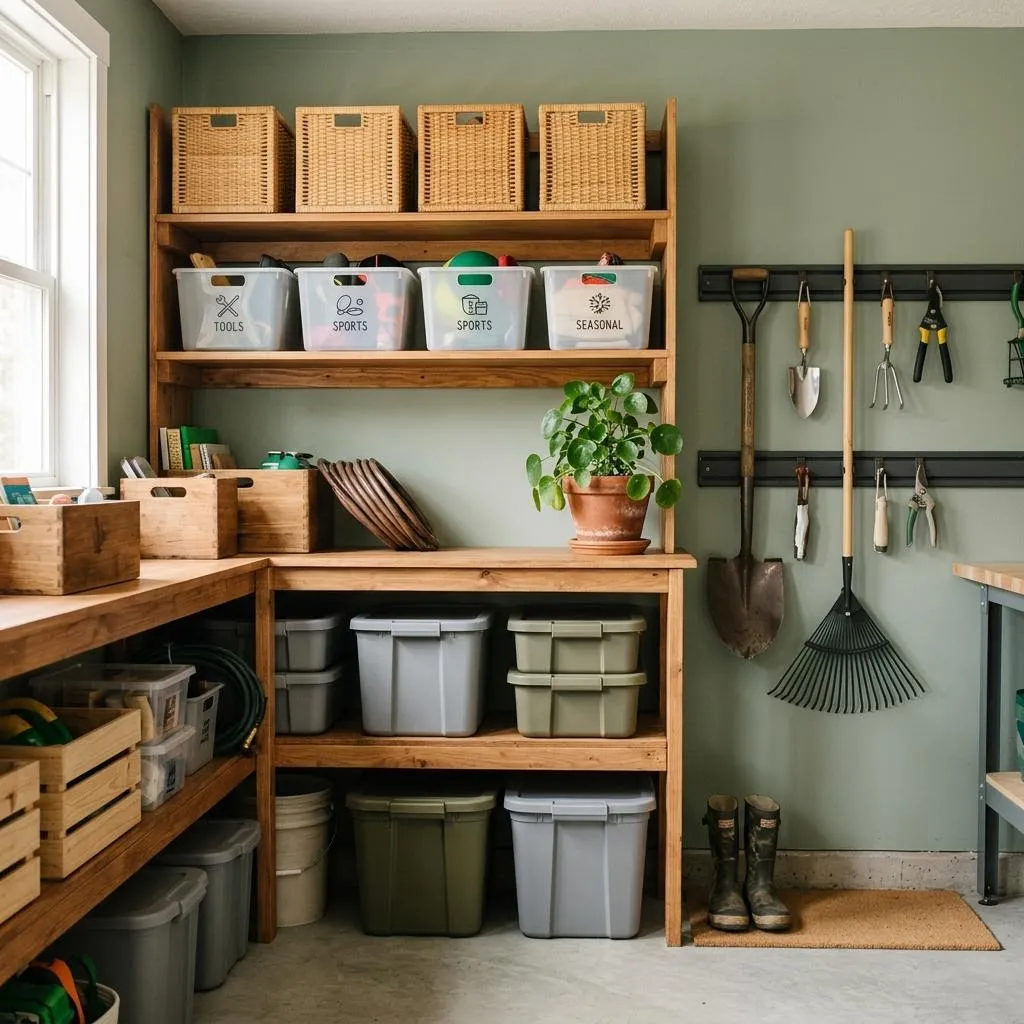
Garage wall storage should help you find a rake or a screwdriver without moving the bikes first. Start with one group of tools, leave room for cars and doors, and choose supports that suit the actual load. Heavy equipment can stay low; you don't need an empty floor everywhere.
Map the garage before adding storage
Sketch doors, parked vehicles, windows, panels, and equipment that needs service access. Open the car doors and garage door fully. Keep the clearances required by the equipment and local rules.
Measure potential wall width and height, but also the depth of stored objects projecting into the room. A bicycle on a hook may occupy more depth than expected. Mark a proposed footprint safely and test the space with vehicles present before committing.
Group tools by job and weight
Put garden tools, sports gear, household tools, and project parts into separate groups. Clear ordinary trash and set damaged equipment aside for repair. Store chemicals under the conditions on their labels, separate from mixed tool bins.
Keep heavy things low and lighter frequently used items within comfortable reach. Do not turn an empty high wall into an overhead lifting task. A stable freestanding shelf may be more suitable than hanging every category.
Give hand tools a visible home
A properly installed tool panel can keep small tools visible. Lay the tools on a table first and decide what actually belongs there. Leave enough room around handles for a comfortable grip.
Check the combined load rating of the panel, hooks, fixings, and wall supports. Confirm the wall construction and hidden utilities before drilling, and get qualified installation help when needed. Leave a simple label where each tool belongs.
Sort screws and fittings into small groups
Sort screws and fittings into sturdy small containers labeled by type and size. Keep sharp pieces and choking hazards secured for your household. Label useful spares while you still remember what they fit.
Leave room between long-handled tools
Measure handle length and head width before selecting holders. Place sharp or heavy heads where they cannot fall onto someone, and keep tools from sliding into paths. Follow the holder's instructions and use suitable mounting.
Allow enough space to remove one tool without knocking its neighbor loose. If a category is rarely used, it can be less convenient, but it still needs safe retrieval. Do not lean a cluster behind the door and call the floor clear.
Keep current sports gear easy to reach
Put current sports gear within reach. For a bike rack, check the bike's weight and tire size against the rack's requirements, along with the wall and mounting instructions. Inspect hooks and straps regularly.
A floor stand may work better than lifting a bike overhead. Choose a spot the person using the bike can reach and return to comfortably.
Check shelf supports and weight limits
| Storage approach | Potential use | Critical planning question |
|---|---|---|
| Wall-mounted tool panel | Small frequently used tools | Are the wall, anchors, panel, and hooks all rated appropriately? |
| Rated wall shelves | Labeled light or moderate supplies | What is the combined load and safe retrieval height? |
| Freestanding shelving | Heavy lower-level storage | Is it stable and secured as required? |
| Dedicated bike mount | Compatible bicycles | Can the user mount and remove the bike safely? |
Put heavy supplies on the lower shelves and distribute weight as the shelving instructions direct. Secure tall units as required. Stop using loose, bent, corroded, or damaged components until they can be assessed or replaced.
Keep hazardous products in their original containers
Keep paint, solvents, fuel, pesticides, and other chemicals in their original labeled containers, under conditions suitable for each product. A garage may be too hot or cold for some materials. Follow requirements for separation, ventilation, secure storage, and disposal.
Never transfer hazardous liquids to food or drink containers. Do not combine remnants. For unwanted products, use appropriate local household hazardous-waste routes. If a container is leaking or damaged, seek proper handling guidance before moving it.
Leave room for maintenance and changing projects
Leave a clear work surface and one small spot for the current project. Label parts and set a date to revisit unfinished work. Keep exits, utilities, and service access clear between projects too.
Try taking tools down and putting them back. If a routine job needs a ladder or several moves, lower that category or change its location. Reserve high storage for light occasional items you can reach safely.
Your first garage session
- Clear exits and necessary access.
- Group one tool category.
- Remove unrelated waste through the right route.
- Record wall construction and utility questions.
- Measure actual item depth and vehicle movement.
- Decide whether existing sound shelving can be rearranged.
Buy or install hardware only after these questions are answered. Do not use improvised fixings as a temporary substitute for a rated installation.
Garage storage questions
Can I use ordinary adhesive hooks for tools?
Use hooks only for the surfaces, conditions, and loads in their instructions. Heavy, sharp, or awkward tools need a mounting system designed for that job.
Should everything leave the floor?
Keep heavy or awkward equipment at floor level or on a suitable low shelf. Clear paths, door movement, and service access matter more than getting every object onto a wall.
For a broader sequence, use room-by-room decluttering and the printable reset checklist.